
A negative maker fee is a rebate on an eligible executed fill. Your exit, funding and price P&L determine whether the whole trade makes or loses money.
A negative maker fee means an eligible executed fill receives a rebate instead of paying a trading commission. It does not mean that placing an order earns money, that both sides of a round trip will qualify, or that the completed trade will be profitable.
When comparing PerpDEX fees, keep the sign of each commission and distinguish an execution rebate from a referral payment or a points award. The exit can cost more than the opening rebate, even before funding and price movement enter the calculation.
Read a negative fee as a signed cash flow
Use positive numbers for commissions paid and negative numbers for commission rebates received:
Net trading commission = sum of (executed notional × signed fee rate)
A hypothetical -0.01% maker rate on a $100,000 fill gives 100,000 × -0.0001 = -$10. In this convention, the negative $10 is a rebate to the trader. A 0.05% taker rate on the same notional gives a positive $50 cost.
Those two rates are invented inputs for the examples below. They are not a current fee quote or a claim that a particular account can obtain a rebate.
As a real example of the mechanism, Hyperliquid's fee documentation separately lists maker rebate tiers and says rebates are credited per trade. Eligibility depends on the applicable schedule. A negative entry in a comparison table should therefore lead to an account-level check, not an assumption that every new trader qualifies.
Calculate both entry and exit
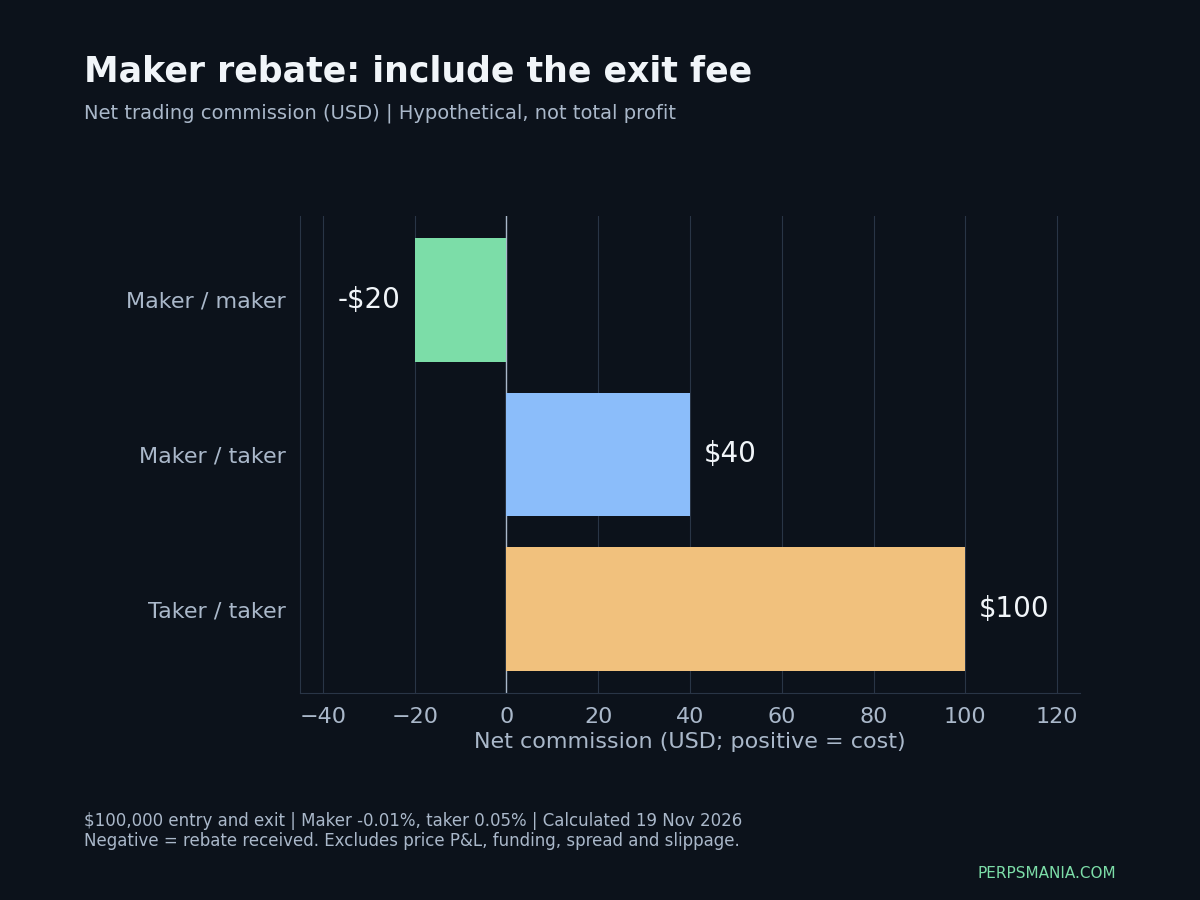
Assume a fictional linear USD-valued perpetual with a $100,000 entry and an unchanged $100,000 exit. Eligible maker fills receive -0.01%; taker fills pay 0.05%. Count one fill on entry and one on exit, without adding funding or execution costs yet.
| Entry / exit role | Entry commission | Exit commission | Net trading commission |
|---|---|---|---|
| Maker / maker | -$10 | -$10 | -$20 rebate |
| Maker / taker | -$10 | $50 | $40 cost |
| Taker / taker | $50 | $50 | $100 cost |
The maker/taker row is -$10 + $50 = $40. An opening rebate reduces the final bill; it does not erase the cost of crossing the book on exit. The maker/maker row requires both executions to qualify at the assumed rate, which may not happen.
If closing notional changes with price, apply the actual closing notional rather than copying the opening amount. For partial fills, calculate each filled quantity separately and use the role and rate recorded for that execution.
Posting an order is different from earning a rebate
A submitted limit order may rest without filling, partially fill, or immediately execute against another order. A rebate calculation needs eligible executed notional, not the face value of every order you submitted or canceled.
Hyperliquid's order documentation describes post-only as a resting-order option. It helps control execution role; it does not guarantee a fill, a particular rebate tier or a profitable exit. Read our post-only and IOC guide before treating an order instruction as a fee entitlement.
An urgent close may need taker execution. Budgeting for that possibility is more informative than assuming both sides will always receive the most favorable maker rate.
A commission rebate is not total profit
Separate the commission ledger from the position's price P&L. Suppose the fictional maker/maker round trip receives the $20 net rebate in the table, but incurs $80 of adverse price P&L and pays $5 of funding. The simplified net result is:
-$80 price P&L + $20 rebate - $5 funding = -$65
This is a constructed accounting example, not a reported trading result. It excludes transfer charges and taxes. If a P&L figure already includes fees or funding, do not add them again.
A passive fill can be followed by a price move against the position. The rebate alone does not tell you whether the fill price was favorable, whether you can close at the same price, or how much risk was held between the two executions. Compare execution cost at your actual size and the available exit quote as well as the commission schedule.
Distinguish maker rebates, discounts and points
A fee discount reduces a commission that would otherwise be charged. A negative maker commission credits an eligible fill. A referral commission paid to the person who invited you is a different recipient's cash flow. A delayed fee refund can also have a different settlement time and eligibility condition from an immediate discount.
Check the recipient, qualifying markets, account tier, volume window and crediting method. Do not subtract a referral payment you do not receive, or count one refund both as an immediate discount and as a later rebate.
Points are a separate program measure. Their possible token value belongs in a scenario model, not in the execution-fee column. An assumed future points value does not make a negative current trading result disappear. The points valuation guide explains how to keep those assumptions explicit.
Compare schedules using the same trade
Use the PerpDEX maker/taker comparison as a starting reference. Choose the same contract, notional and intended entry/exit roles for every venue. Then verify the applicable rate on the exchange, including whether the negative maker entry is available to your account and selected market.
Record commissions and rebates from actual fills separately from funding and price P&L. If a two-venue hedge is involved, include both entries and both exits; the funding break-even guide shows why four executions matter.
The useful comparison is the cost and risk of the whole intended trade. A negative maker rate is one input, not a complete reason to choose an exchange or increase turnover.
Sources and assumptions
- Hyperliquid: fees — primary example of published maker rebate tiers and rebate crediting.
- Hyperliquid: order types — primary reference for limit and post-only execution instructions.
Sources checked on 19 November 2026. All trade notionals, -0.01% maker and 0.05% taker rates, price P&L and funding amounts in the worked examples are hypothetical. The table and chart show net commissions only for equal $100,000 entry and exit notionals on a fictional linear USD-valued contract. Actual eligibility, tier changes, fill roles and contract rules must be checked separately. No trading performance, guaranteed rebate availability or guaranteed profit is claimed.
Check your own assumptions
Use the guide as a framework, then inspect the relevant markets and inputs on PerpsMania.
Compare PerpDEX maker and taker ratesEducational material, not personalized investment advice. Numerical examples are hypothetical unless explicitly identified as sourced market data. Perpetual trading can result in loss of all posted collateral. Some product pages contain referral links; PerpsMania may benefit when you use them.