
Post-only controls liquidity-taking behavior, reduce-only controls position direction, and IOC controls the unfilled remainder. Confirm executions and resulting exposure separately.
A perpetual order can control its price, how long it stays active and whether it may increase exposure. These controls answer different questions. Confusing them can leave an exit unfilled or allow an ordinary sell order to open a short after a long has already closed.
This guide uses Hyperliquid's documented order options as a concrete reference. Other venues can use different names and validation rules. Check the exact market before applying the workflow elsewhere.
Separate three decisions before submitting
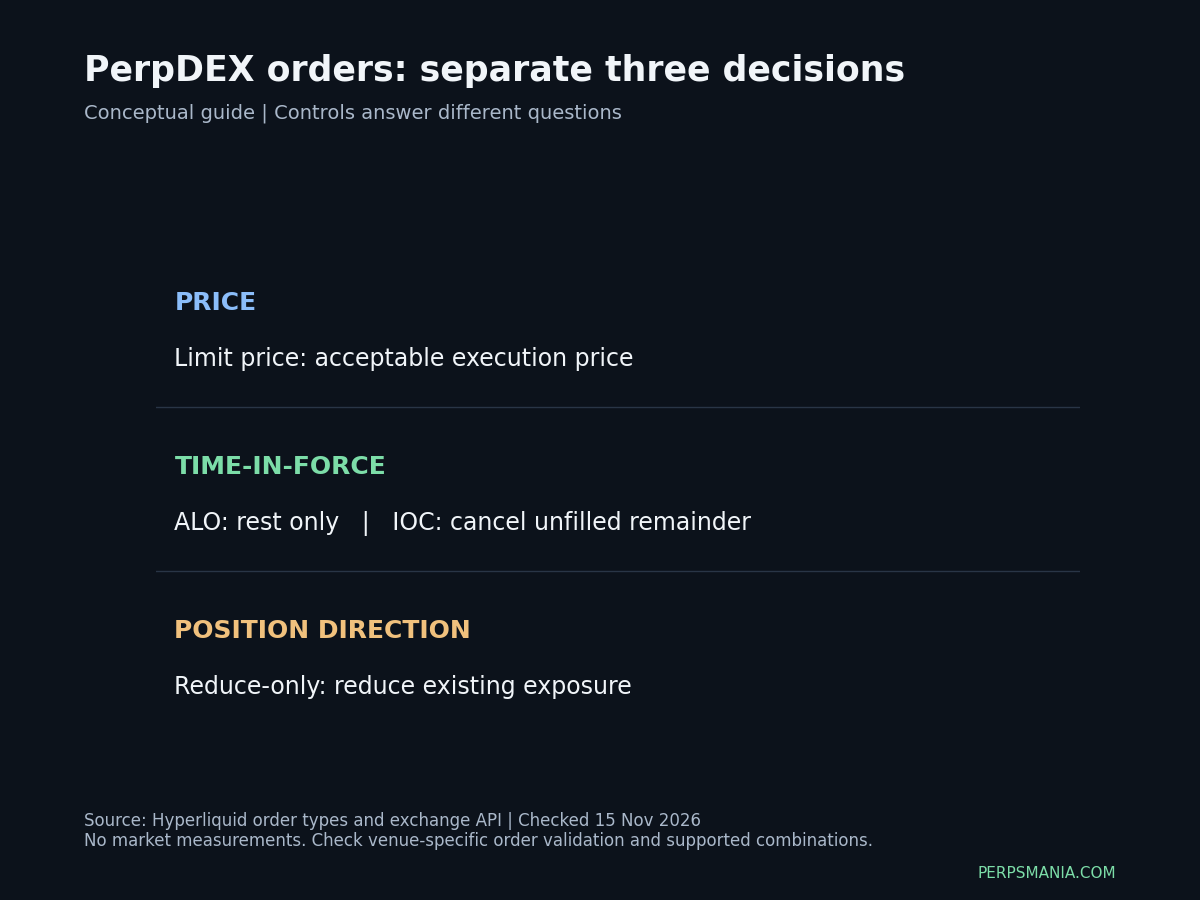
The order-types documentation distinguishes price instructions, time-in-force and position-reduction options. A limit price defines an acceptable execution price. Post-only determines whether an order may immediately remove liquidity. Reduce-only restricts its effect on a position.
| Control | Question it answers | What it does not establish |
|---|---|---|
| Limit price | What price is acceptable? | That the fill will be maker |
| Post-only / ALO | Must this order rest rather than immediately match? | That it will fill or reduce exposure |
| Reduce-only | Must execution reduce an existing position? | That the order will execute immediately |
| IOC | Should an unfilled remainder be cancelled immediately? | That the full requested size will fill |
Why a limit order can pay taker fees
A limit order can execute immediately if its price crosses available opposing liquidity. Its price boundary does not by itself require a resting maker fill. Calling an order a limit order therefore does not complete a fee budget.
Hyperliquid's exchange API documentation specifies that an ALO order is cancelled instead of immediately matching. IOC cancels any unfilled portion rather than leaving it resting. The request represents reduce-only separately from these time-in-force choices.
For a planned entry, decide whether a resting quote is acceptable. If the order must be post-only, a cancellation can be the intended outcome when the market moves. Check the response before replacing it. Automatically changing a cancelled post-only order into an aggressive order changes the execution instruction and potentially its fee role.
Use PerpsMania's exchange comparison to research maker and taker schedules, then verify the effective account rate. For execution-price measurement, see order-book VWAP and slippage.
Reduce-only protects position direction, not execution timing
Hyperliquid describes reduce-only as reducing a current position instead of opening the opposite position. A resting reduce-only exit can still remain unfilled. It should not be treated as evidence that exposure has already disappeared.
Consider a hypothetical trader who places an ordinary sell limit to close a long, then closes the long through another order. If the original sell is still active, its later execution could create a new short where the venue permits it. A suitable reduce-only instruction addresses this direction risk. The venue's actual handling of oversized or conflicting exits must still be checked.
Record the live position alongside outstanding exits. A label in an order ticket describes an instruction; the account's position and execution ledger establish what happened. Avoid judging hedge completion from an order-submission confirmation alone.
IOC can leave a funding hedge incomplete
An immediate-or-cancel order can fill only part of the requested size before cancelling the rest. A successful submission therefore does not prove that two venues hold matching exposure.
After submitting a hedge, inspect the executed size on both venues. Reconcile remaining exposure in consistent base units or equivalent delta, then decide how to handle the unmatched portion. Do not blindly resend the original full quantity: some of it may already have filled.
This is a different question from whether the funding spread looked attractive before execution. The funding arbitrage guide explains the wider trade, while separate margin buffers remain necessary even after both legs are matched.
A practical order review workflow
Before placing an order, write down its purpose: open exposure, add exposure or close exposure. Then choose the acceptable price, whether immediate matching is allowed and whether any remainder may rest. Apply the position-reduction constraint separately where supported.
After the response, distinguish rejection, cancellation, resting status, partial execution and completed execution. Inspect the resulting position before another order changes the account. For exits, review other outstanding orders that might become unnecessary or conflict with the current position.
These steps improve accounting clarity; they do not guarantee a fill, lower total trading cost or protection against liquidation. A passive order can miss a needed exit, while an aggressive order can incur execution shortfall. The appropriate instruction depends on the specific trading objective and market.
Sources and assumptions
- Hyperliquid: order types — limit orders, post-only, reduce-only and IOC options.
- Hyperliquid: exchange endpoint — ALO cancellation, IOC remainder handling and separate reduce-only field.
Sources checked on 15 November 2026. Position examples are hypothetical and contain no measured fills, fees, returns or market prices. The diagram is a conceptual comparison, not a ranking of venues. Interface labels and order-validation behavior can differ across exchanges; this guide establishes no universal rule for conflicting exits or oversized reduce-only orders.
Check your own assumptions
Use the guide as a framework, then inspect the relevant markets and inputs on PerpsMania.
Compare PerpDEX trading feesEducational material, not personalized investment advice. Numerical examples are hypothetical unless explicitly identified as sourced market data. Perpetual trading can result in loss of all posted collateral. Some product pages contain referral links; PerpsMania may benefit when you use them.