
A points estimate is a scenario built from assumptions. It is not a token entitlement or a realizable cash balance.
A points balance measures participation under a project's rules. It does not by itself establish a cash value. An airdrop calculator becomes useful when it makes assumptions visible and lets you test how much the result changes when those assumptions are wrong.
Separate a balance from an entitlement
Before assigning a number to points, check whether the project has committed to a token distribution, defined eligible participants and explained conversion. A points balance alone does not answer those questions.
For a concrete example of cautious terms, Extended's points documentation says its cumulative points figure does not imply monetary value, token allocation or future entitlement. That is a statement about this program; check each project's own terms independently.
Build a transparent valuation scenario
For a simplified pro-rata distribution, the hypothetical nominal value is:
FDV × share of supply allocated to eligible points × your share of eligible points
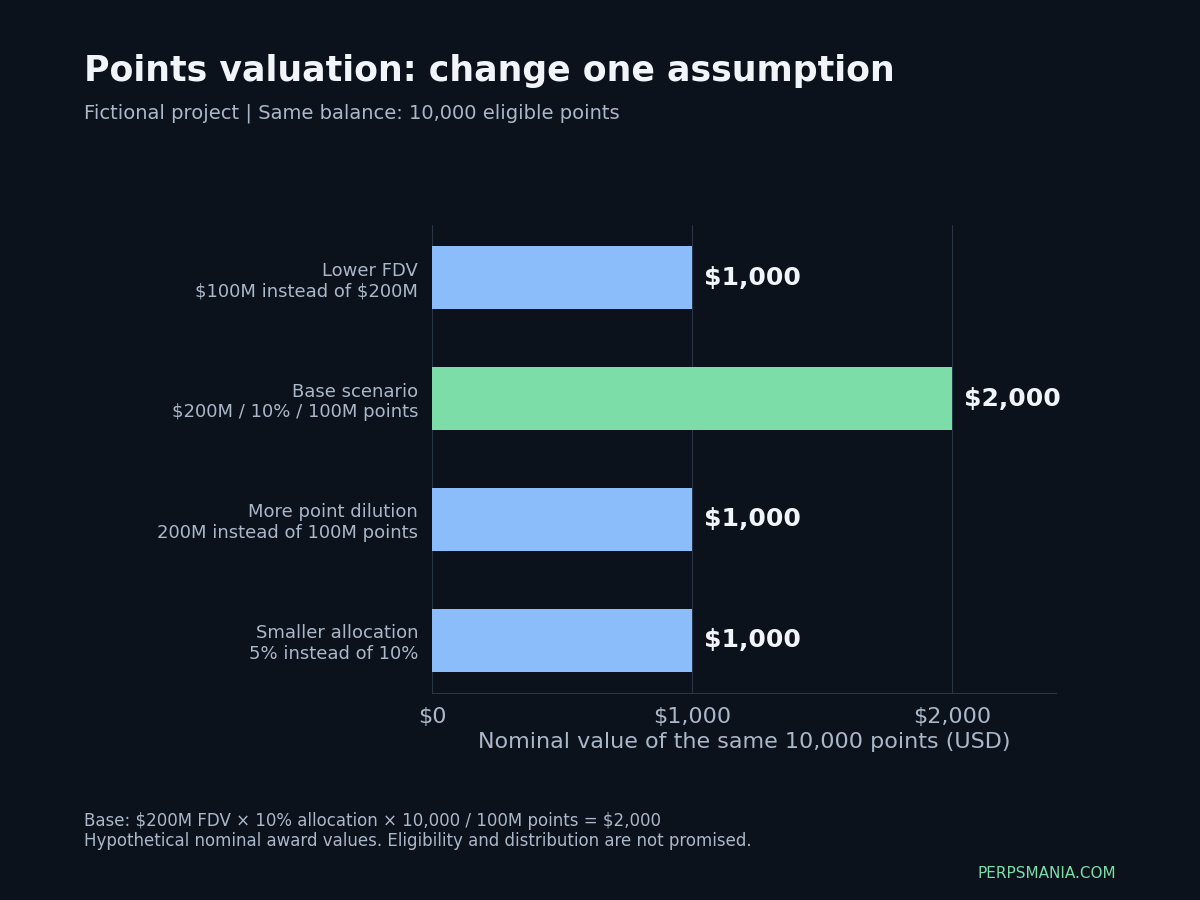
Suppose an imaginary project has a $200 million fully diluted valuation, allocates 10% of supply to one points pool, and has 100 million eligible points at conversion. A participant holds 10,000 of those points.
Their share is 10,000 ÷ 100,000,000 = 0.01%. The implied pool value is $20 million. The participant's nominal allocation value is therefore $2,000 at the assumed token price.
This arithmetic assumes identical weighting and full eligibility. Tiered allocations, caps, season weights and anti-abuse exclusions can invalidate a simple pro-rata model. The example does not describe any named project.
Stress-test the unknown inputs
| Scenario | FDV | Pool share | Total eligible points | Nominal value for 10,000 points |
|---|---|---|---|---|
| Lower valuation | $100M | 10% | 100M | $1,000 |
| Base illustration | $200M | 10% | 100M | $2,000 |
| More point dilution | $200M | 10% | 200M | $1,000 |
| Smaller allocation | $200M | 5% | 100M | $1,000 |
More points issued to other participants can reduce your share even if your own balance never changes. Future issuance belongs in the denominator. Also model the possibility of no eligible distribution: its reward value is zero, while incurred trading costs remain real.
Distinguish nominal value from realizable proceeds
FDV uses total token supply and an assumed token price. It is not the amount of cash available to token holders. An allocation may be locked or vested; immediate liquidity can be limited; selling can move the price.
If only part of the allocation unlocks initially, show unlocked and locked portions separately. Do not present a nominal mark on locked tokens as cash that can be withdrawn at launch.
Compare reward scenarios with actual costs
Record trading fees, spreads, slippage, funding and any losses incurred while pursuing points. In an illustrative case, spending $600 to obtain a modeled $2,000 allocation produces a $1,400 scenario surplus, but a $500 allocation produces a $100 loss. No distribution leaves the full $600 cost unrecovered.
Use PerpsMania's calculators to change assumptions, and the points page to research programs. For a project-specific walkthrough, compare Variational point prices across FDV scenarios. Save your inputs and their source dates so an updated estimate can be explained rather than silently replacing an earlier one.
For another project-specific model, use the RiseX points calculator. Its allocation and FDV are scenario inputs; compare them with the project research rather than treating the default result as a confirmed reward.
Sources and assumptions
- Extended: points program — an example of program terms, not an input to the hypothetical valuation.
Source checked on 29 October 2026. All valuation scenarios are invented and exclude taxes. No token price, conversion ratio, eligibility or future distribution is promised.
Check your own assumptions
Use the guide as a framework, then inspect the relevant markets and inputs on PerpsMania.
Model an airdrop scenarioEducational material, not personalized investment advice. Numerical examples are hypothetical unless explicitly identified as sourced market data. Perpetual trading can result in loss of all posted collateral. Some product pages contain referral links; PerpsMania may benefit when you use them.