
TxFlow points have no fixed volume conversion. Budget each fill and any eligible referral discount, then measure cost per awarded point from a completed epoch.
TxFlow Points are tied to genuine perpetual trading, while the cost of participating arrives in USDC. This guide separates published program rules from a worked trading budget: how maker and taker fills change the bill, what a referral discount actually saves, and how to measure cost per point after a distribution.
What TxFlow is and what earns points
TxFlow describes its product as a Layer 1 with native perpetual, spot and prediction-market trading. Those products do not all qualify for the same rewards.
The Season 1 rules publish 1,250,000 trader points per week, with Monday-to-Monday UTC epochs and Tuesday credits. Season 1 began on 12 October 2026; weekly distributions are scheduled to end no later than Q1 2027. This is a schedule, not an announced token launch date.
Both maker and taker perpetual fills can qualify. Volume, open interest, activity over time, fees and capital contribute to scoring, whose weights and minimum activity threshold are unpublished. There is no official fixed points-per-dollar rate. Spot trades, prediction markets, unfilled cancellations and depositing alone do not qualify. Wash trading and artificial activity can lose points.
The referral pool is separate: up to 152,000 points weekly. The 488,000-point growth reserve is a monthly budget. Do not add it to a weekly pool as if the periods matched. For a product overview and separately labelled community observations, see our TxFlow research page.
Start with your effective trading fee
The published fee schedule sets VIP 0 perpetual fees at 0.0150% maker and 0.0450% taker, below $5 million of rolling 14-day weighted volume. Each fill is charged on notional. Opening and closing are separate executions.
A limit order is not automatically a maker fill: it can cross the book. Post-only orders can enforce the liquidity role but do not guarantee execution. Confirm your actual tier and market rates before budgeting; the schedule and volume parameters can change.
Assume a hypothetical entry and exit of $10,000 each, at the same VIP 0 rates and with no change in exit notional:
Round-trip fee = entry notional × entry rate + exit notional × exit rate
| Fill combination | Entry fee | Exit fee | Total before discount | With eligible 5% fee discount |
|---|---|---|---|---|
| Maker entry, maker exit | $1.50 | $1.50 | $3.00 | $2.85 |
| Maker entry, taker exit | $1.50 | $4.50 | $6.00 | $5.70 |
| Taker entry, taker exit | $4.50 | $4.50 | $9.00 | $8.55 |
For example, 10,000 × 0.00045 × 2 = $9. The discount then saves $9 × 0.05 = $0.45, leaving $8.55. It does not save 5% of the $20,000 turnover. If your exit size or price differs, calculate its notional separately instead of doubling the entry fee.
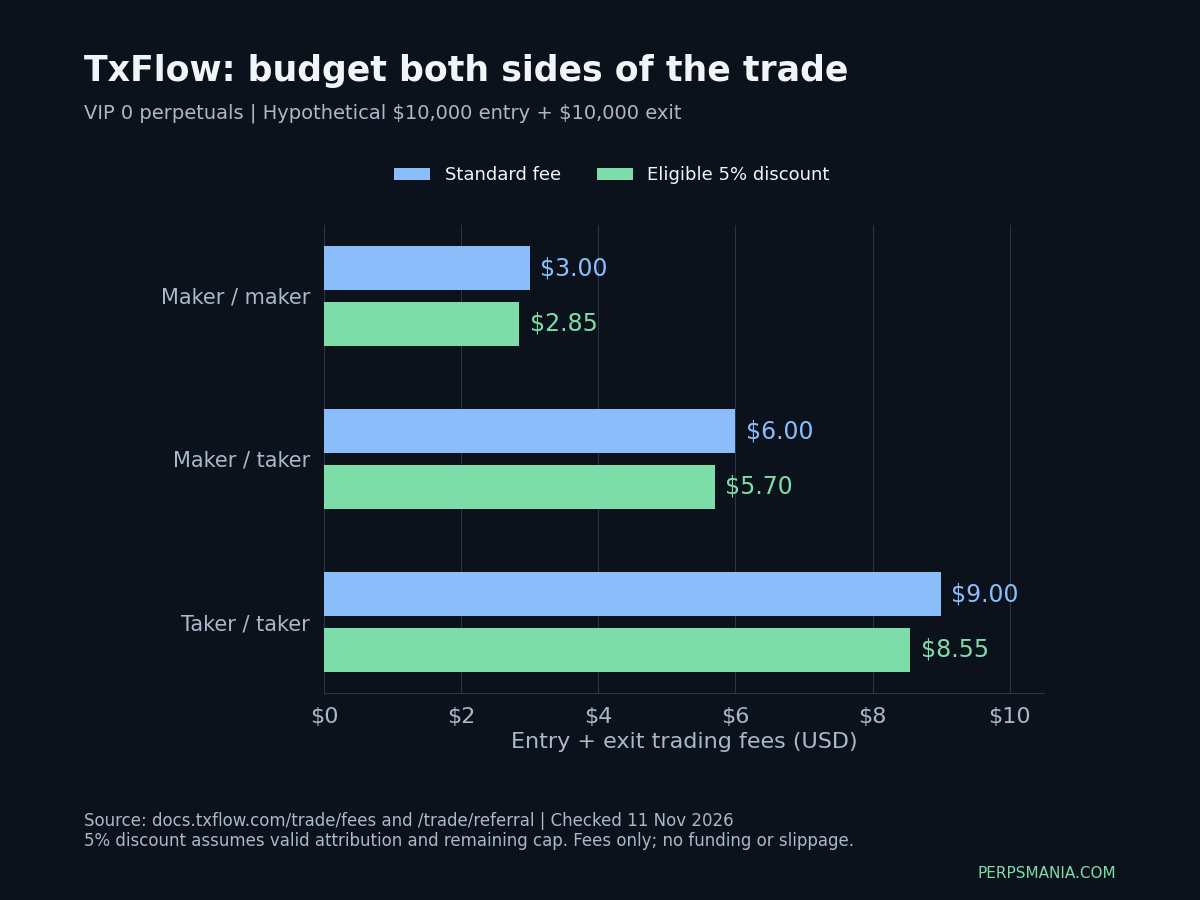
A maker exit may wait or never fill. Its lower explicit fee is therefore not a complete execution comparison. Use order-book VWAP and slippage to compare the realized price as well.
Keep the referral benefit separate from points
The referral rules currently offer referred users 5% off spot and perpetual trading fees on their first $25 million of combined volume. A bound code is permanent. Check attribution and your remaining cap in the account; an article cannot verify either.
You can open TxFlow through the PerpsMania referral link. Referral disclosure: PerpsMania may earn a commission from qualifying trading activity. The fee discount is subject to TxFlow's current terms and account eligibility. It is separate from any points reward and does not promise a token allocation.
Calculate cost per point after the weekly credit
A useful measurement is an after-the-fact participation cost, not a forecast of points generated by more turnover. Reconcile actual entry and exit fees, credited discounts, funding and execution costs over the same completed epoch as the points award.
Cost per awarded point = attributable participation costs ÷ actual awarded points
Here is an invented sensitivity example, not a TxFlow earning rate. Assume the discounted taker round trip above costs $8.55, plus $3 of funding paid and $2 of execution shortfall, for $13.55 in total. There is no additional builder fee or fee credit in this scenario.
| Hypothetical awarded points for the measured activity | Assumed costs | Cost per point |
|---|---|---|
| 50 | $13.55 | $0.2710 |
| 100 | $13.55 | $0.1355 |
| 250 | $13.55 | $0.0542 |
These point counts are deliberately hypothetical and cannot be inferred from the $20,000 turnover. If no points are awarded, the ratio is undefined; the $13.55 cost still exists. For a real account, use the actual eligible award and avoid counting unrelated referral points against only your own trading costs.
TxFlow funding is a transfer between traders, with an hourly default settlement cycle. Use actual settled amounts and the market's configured interval. A receipt reduces the cost ledger; a payment increases it. The $3 above is an invented input, not a current funding quote.
Keep realized price P&L separate from this cost ratio. For example, a hypothetical $5 gross price profit still leaves $5 − $13.55 = −$8.55 after the assumed costs. Points do not erase that cash loss.
Use the calculator for scenarios, not entitlements
The PerpsMania TxFlow calculator lets you vary FDV, allocation and the final point pool. Its supply model includes planning assumptions about future weekly credits and pool usage; it is not an independently verified final eligible supply.
Hypothetical nominal value per point = assumed FDV × assumed token allocation ÷ assumed eligible points
Change one assumption at a time and keep a record of it. A larger eligible pool reduces value per point when FDV and allocation stay fixed. Neither a spreadsheet result nor a low measured participation cost establishes that a distribution will occur, or that tokens can be sold at the assumed price.
The program terms say points are non-transferable and are not currency. Future token-distribution details will be announced separately; third-party calculators do not determine awards. Scoring, pools and schedules can change, and ineligible farming activity can be adjusted retroactively. Check platform eligibility before onboarding.
Sources and assumptions
- TxFlow introduction — product and execution architecture.
- How Points Work — Season 1 schedule, eligible activity and pool periods.
- Fees & Discounts — VIP 0 rates, rolling volume and per-fill fees.
- Referral — documented discount, combined-volume cap and binding rules.
- Funding — payment direction and settlement mechanics.
- Points Program Terms — eligibility, adjustments and future-distribution limitations.
Sources checked on 11 November 2026. All trade sizes, unchanged entry/exit notionals, funding and execution-cost inputs, point-award scenarios and price P&L examples are hypothetical. Discount examples assume valid attribution and an unused cap. Calculations exclude transfer charges, taxes, liquidation costs, builder fees and campaign fee credits; they are not a complete account statement or a token-price forecast.
Check your own assumptions
Use the guide as a framework, then inspect the relevant markets and inputs on PerpsMania.
Model a TxFlow points-value scenarioEducational material, not personalized investment advice. Numerical examples are hypothetical unless explicitly identified as sourced market data. Perpetual trading can result in loss of all posted collateral. Some product pages contain referral links; PerpsMania may benefit when you use them.