
QFEX fees vary by asset class and account tier. Model entry and exit fills separately, then account for credited referral refunds, funding and execution costs.
QFEX offers perpetual exposure to traditional markets, but the cost of a trade depends on the asset class, account tier and how each order fills. This guide turns the published fee schedule into a worked round-trip budget and separates the referral refund from funding and execution costs.
What QFEX trades
QFEX describes itself as a hybrid exchange using a central limit order book for traditional-asset perpetuals. Its FAQ lists USDC-margined equity, index and commodity products. These are derivatives: buying an equity perpetual is not the same transaction as buying shares through a stockbroker.
Check the live contract and its reference market before placing an order. A familiar ticker does not make two venues' products interchangeable. Contract size, price references and trading restrictions belong in the comparison alongside fees.
Check the fee for your asset class
The official fee table lists these Tier 5 rates below $2 million of effective trailing-30-day volume:
| Asset class | Maker per fill | Taker per fill |
|---|---|---|
| Commodities | 0.02% | 0.05% |
| Indices | 0.02% | 0.05% |
| Single stocks | 0.05% | 0.10% |
Effective volume weights commodity and index volume by 2, and single-stock volume by 5. Fees use the tier in effect when the order is placed; updates can lag. The page also describes a lowest-tier promotion for users who had already deposited at the August 24, 2026 cutoff, on specified products. Do not assume a new account qualifies.
The table is a dated reference, not a replacement for your account's displayed fees. A marketable limit order can take liquidity; calling an order a limit order does not establish its maker rate.
Calculate a round trip on $10,000 per side
Assume one hypothetical entry and one exit, each with $10,000 executed notional, unchanged between fills. There is no price profit or loss in this fee-only comparison.
Trading fees = entry notional × entry rate + exit notional × exit rate
| Asset and execution | Entry fee | Exit fee | Gross round-trip fee |
|---|---|---|---|
| Commodity or index, maker both ways | $2 | $2 | $4 |
| Commodity or index, maker entry and taker exit | $2 | $5 | $7 |
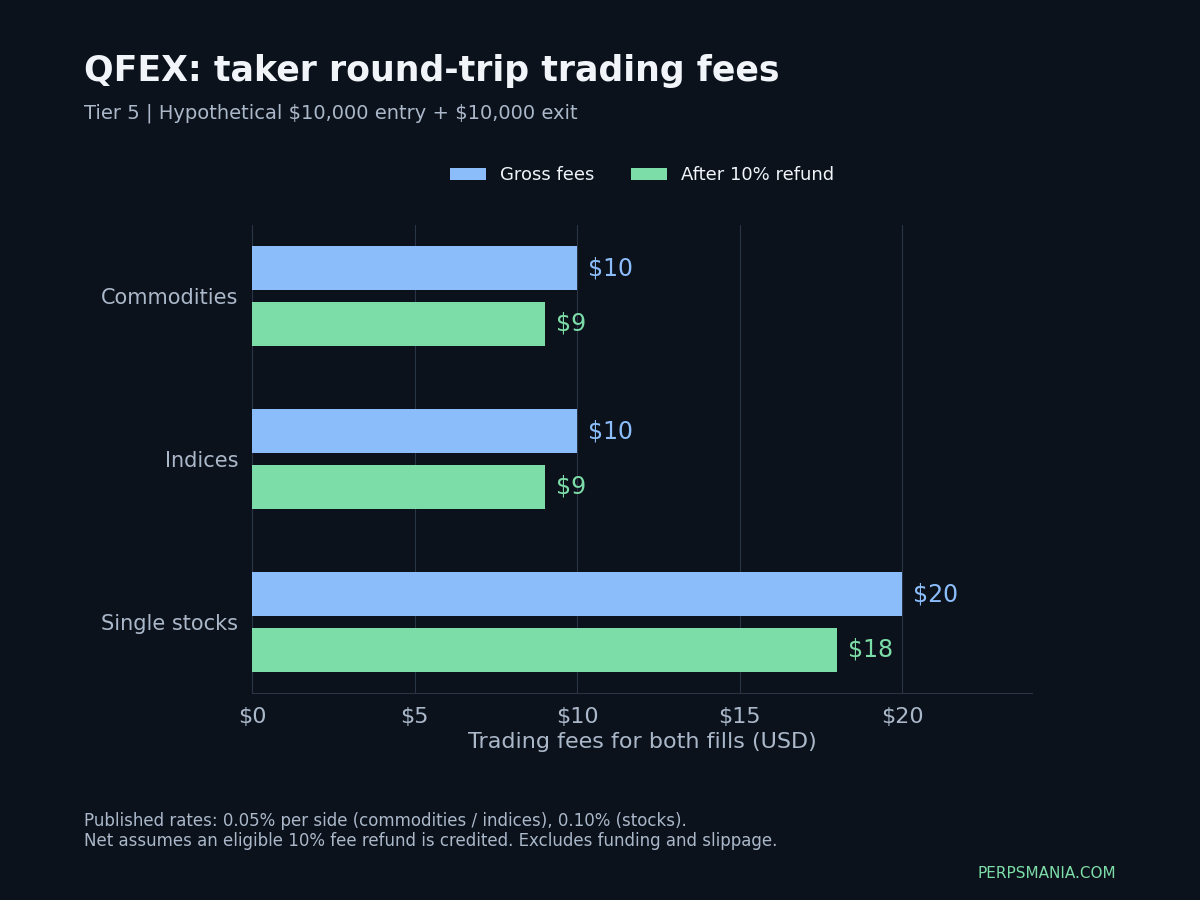
| Commodity or index, taker both ways | $5 | $5 | $10 |
| Single stock, maker both ways | $5 | $5 | $10 |
| Single stock, maker entry and taker exit | $5 | $10 | $15 |
| Single stock, taker both ways | $10 | $10 | $20 |
For example, 10,000 × 0.10% × 2 = $20. The rates apply to executed notional, not simply the collateral deposited. Using less collateral for the same exposure does not reduce this dollar fee calculation.
If the exit notional changes with price, recompute that leg instead of doubling the entry fee. Partial fills can also have different liquidity roles, so reconcile the actual execution records rather than assuming the entire order filled at one rate.
Apply the referral refund separately
The referral documentation states that referred users receive a 10% trading-fee discount, processed as a refund around 00:10 UTC. Treat this as a fee refund to verify in the account ledger, rather than assuming every fill is initially charged at a reduced rate.
Assuming the full trading fee in the example is eligible and the refund is credited:
| Gross trading fees | Hypothetical 10% refund | Net trading fees after refund |
|---|---|---|
| $4 | $0.40 | $3.60 |
| $7 | $0.70 | $6.30 |
| $10 | $1 | $9 |
| $15 | $1.50 | $13.50 |
| $20 | $2 | $18 |
The reduction is 10% of eligible fees, not 10% of trade size. On a $20 fee bill, that means $2, not $1,000. A refund also does not remove spread, slippage or adverse price moves.
You can open QFEX through the PerpsMania referral link. Referral disclosure: PerpsMania may earn a commission from qualifying trading activity through this link. Confirm referral attribution and the current benefit in QFEX before trading; this article does not promise account eligibility or a particular reward.
Budget funding and execution beyond fees
QFEX's funding rules specify hourly calculation and settlement, active only during each symbol's configured funding hours. Outside those hours the rate is zero and no payment is exchanged. Continuous trading access therefore does not mean continuous funding payments. Consult the symbol's current schedule rather than extrapolating one displayed rate across every hour of the week.
Consider a separate hypothetical single-stock taker round trip. Start with the $18 net trading fee above. Assume an additional $3 funding payment and $4 total execution shortfall, measured against recorded reference prices and excluding the explicit fees.
Modeled total cost = $18 + $3 + $4 = $25
That is 0.25% of a $10,000 reference notional. A $20 gross trading gain would leave a $5 loss after these assumed costs. The $3 and $4 inputs are invented, not observed QFEX rates or measured trading results. If funding is received, enter the receipt with the opposite sign; if the position changes size, use actual settled amounts.
For execution details, see order-book VWAP and slippage. Use PerpsMania's exchange comparison to research alternatives, then verify the exact contract and account terms directly.
Before the first trade
QFEX's FAQ says an invitation is not required for users meeting onboarding requirements; a referral can provide a fee benefit. Availability remains restricted by location. Read the current FAQ and restrictions before onboarding, and confirm your account's fee tier and referral status.
Keep a small ledger of entry and exit notionals, execution fees, credited refunds, funding and realized price P&L. That makes the cost of participation visible without assigning speculative value to a possible token or airdrop. This guide establishes no points conversion, token allocation or TGE date.
Sources and assumptions
- QFEX: about — hybrid order-book exchange description.
- QFEX: FAQ — products, onboarding and restrictions.
- QFEX: fees — asset-class rates, effective volume and historical depositor promotion.
- QFEX: referral program — documented discount and refund processing.
- QFEX: funding — settlement interval and symbol-specific active hours.
Sources checked on 3 November 2026. Published terms can change. The $10,000 position sizes, unchanged entry/exit notionals, funding payment and execution shortfall are hypothetical. Examples assume Tier 5 without the historical depositor promotion; refund examples additionally assume eligibility and successful credit. Taxes, transfer costs and liquidation costs are excluded. No trading outcome or future distribution is guaranteed.
Check your own assumptions
Use the guide as a framework, then inspect the relevant markets and inputs on PerpsMania.
Compare perpetual exchanges and feesEducational material, not personalized investment advice. Numerical examples are hypothetical unless explicitly identified as sourced market data. Perpetual trading can result in loss of all posted collateral. Some product pages contain referral links; PerpsMania may benefit when you use them.