
At a hypothetical $300M FDV, 15% allocation and 10M eligible points, the model implies $4.50 per point. These inputs are assumptions, not final airdrop terms.
RISEx points have a weekly distribution schedule, but a dollar value still requires assumptions about token allocation, valuation and the eligible point pool. This guide explains what Season 1 publishes, reproduces the inputs in our RiseX calculator, and adds a trading-cost check before you compare rewards with money spent.
What Season 1 actually publishes
The official Season 1 announcement describes Ignite as beginning on 20 July 2026, with 200,000 points per weekly distribution and an expected conclusion no later than Q2 2027. The first distribution was scheduled for 28 July at 14:00 UTC. An expected season end is not a token launch date.
The current points documentation lists maker and taker volume, fees and execution costs, open interest, holding time and referrals among qualifying factors. The model changes weekly and its exact weights are not public. More turnover therefore cannot be converted into a fixed promised number of points.
It also says that 100% of RISE points go to RISEx users. That describes who receives points. It does not state that 100% of token supply goes to point holders. The sources reviewed for this guide do not establish the calculator's 15% token-allocation input or its 10 million-point denominator as final distribution terms.
Use our RiseX project page for the product overview and separately labelled community observations. Treat reported user outcomes as observations about particular accounts and periods, not the official scoring formula.
Reproduce the calculator's $4.50 scenario
The RiseX points calculator starts with a $300 million FDV, 15% allocation and a fixed 10 million-point model reference. FDV and allocation are editable. These defaults are modelling choices, not a guaranteed airdrop or a live trading quote.
Implied value per point = assumed FDV × assumed allocation ÷ assumed eligible points
At those inputs:
- Hypothetical value assigned to the point-holder pool:
$300,000,000 × 0.15 = $45,000,000. - Implied value per point:
$45,000,000 ÷ 10,000,000 = $4.50. - A hypothetical 1,000-point balance:
1,000 × $4.50 = $4,500.
The balance represents 0.01% of the assumed pool: 1,000 ÷ 10,000,000 × 100. It does not represent 0.01% of all tokens unless the entire supply were allocated to that pool, which this scenario does not assume.
Compare FDV and token-allocation assumptions
Keep the denominator fixed at 10 million model points and vary the other two inputs. Every dollar figure below is a nominal scenario value per point, not an executable price.
| Assumed FDV | Assumed 10% allocation | Assumed 15% allocation | Assumed 20% allocation |
|---|---|---|---|
| $150 million | $1.50 | $2.25 | $3.00 |
| $300 million | $3.00 | $4.50 | $6.00 |
| $500 million | $5.00 | $7.50 | $10.00 |
| $1 billion | $10.00 | $15.00 | $20.00 |
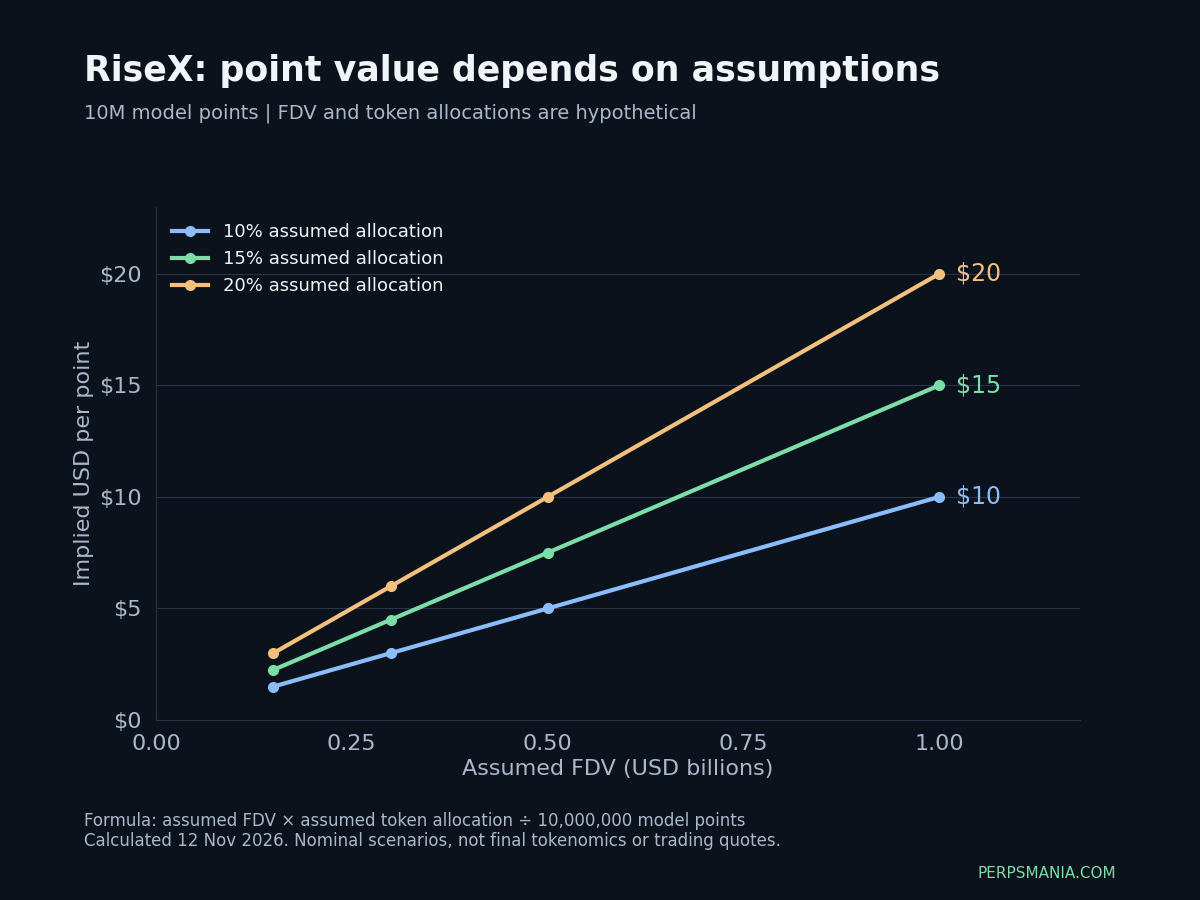
For 1,000 points, multiply each table cell by 1,000. At $500 million FDV and 15%, that is $7,500. At the same FDV and 10%, it is $5,000. The $2,500 difference comes entirely from changing the assumed allocation, without earning a single additional point.
Do not combine a total-supply allocation with circulating market cap as though it were FDV. See FDV, market cap and token unlocks for consistent supply denominators and the distinction between a full award and an initially unlocked portion.
Stress-test the point denominator separately
Our calculator currently fixes its reference at 10 million points. It does not independently reconcile a final eligible snapshot, and it does not expose a point-pool input. A larger-pool sensitivity must therefore be calculated separately rather than presented as a setting already available in the tool.
At $300 million FDV and 15% allocation:
| Hypothetical eligible pool | Value per point | Value of 1,000 points |
|---|---|---|
| 10 million | $4.50 | $4,500 |
| 12 million | $3.75 | $3,750 |
The second row is $45,000,000 ÷ 12,000,000. A 20% larger denominator lowers value per point by 16.67%, not 20%, because value is inversely proportional to the pool. These are sensitivity inputs, not claims that either number is the final issued or eligible supply.
Weekly emissions alone do not establish that denominator. A final model must also specify which seasons, referral awards and other distributions are eligible, their relative weights, and the cutoff. Do not reconstruct a definitive supply merely by multiplying elapsed calendar weeks by 200,000.
Check trading costs before assigning reward value
The official fee schedule uses rolling 14-day volume. At Tier 1 it lists 1 basis point maker and 3 basis points taker: 0.01% and 0.03% per fill. The schedule also says there is no current maker rebate program. Verify your account's effective rate before executing.
For a hypothetical $10,000 entry and a $10,000 exit, both at Tier 1 and with unchanged exit notional:
| Entry and exit fills | Calculation | Trading fees |
|---|---|---|
| Maker and maker | $10,000 × (0.01% + 0.01%) | $2 |
| Maker and taker | $10,000 × (0.01% + 0.03%) | $4 |
| Taker and taker | $10,000 × (0.03% + 0.03%) | $6 |
The fees depend on executed notional, not deposited collateral. A maker order may wait or remain unfilled; the lower explicit fee does not settle the execution-quality comparison. Funding, slippage and any additional routing fee sit outside this table. RISEx funding documentation describes hourly payments and uses oracle/index price to value position notional; use settled amounts for a real ledger.
For a purely hypothetical accounting example, suppose a completed activity period costs $6 in trading fees, $2 in funding paid and $1 in measured execution shortfall. Total participation cost is $9. If the matching activity were awarded 20 points, measured cost would be $9 ÷ 20 = $0.45 per point.
The 20-point award is invented. It is not a claim that this trading volume earns 20 points. A model value of $4.50 per point is ten times that assumed cost, but this ratio is not a tenfold realized return: no sale proceeds, eligibility, unlock schedule or market price have been established. Keep trading P&L separate and record actual receipts only when they occur.
Referral terms and a practical next step
The referral documentation describes a referrer's additional 10% of referred users' points. Affiliate boosts and fee rebates belong to a separate invited program. Do not interpret the referrer's points share as a universal 10% fee discount for the referred trader.
You can visit RISEx through the PerpsMania referral link. Referral disclosure: PerpsMania may receive points or other affiliate benefits from qualifying activity through this link. Check the terms displayed in RISEx for your account; this guide does not promise a particular boost, rebate or token award.
Start by entering your actual balance into the RiseX calculator, then test multiple FDV and allocation assumptions. Record the fixed denominator alongside your result. Compare it with an actual cost ledger and revisit the model when official distribution terms become available.
Sources and assumptions
- RISE: Season 1 Ignite announcement — published schedule and program overview.
- RISEx: points — qualifying factors and allocation of points to users.
- RISEx: fees — Tier 1 rates and 14-day volume tiers.
- RISEx: funding — payment interval and notional-price reference.
- RISEx: referrals and affiliates — distinction between referral points and private affiliate benefits.
Sources checked on 12 November 2026, including the official Markdown versions linked by the documentation pages. FDV, 10%/15%/20% token allocations, 10M/12M eligible pools, point balances, trade sizes, execution combinations and the $9 cost example are hypothetical modelling inputs. They do not establish final tokenomics, eligibility or a TGE date. The fee table excludes funding, execution shortfall, routing charges, taxes, transfers and liquidation. No community account result is used as an official earning rate.
Check your own assumptions
Use the guide as a framework, then inspect the relevant markets and inputs on PerpsMania.
Calculate a RiseX points-value scenarioEducational material, not personalized investment advice. Numerical examples are hypothetical unless explicitly identified as sourced market data. Perpetual trading can result in loss of all posted collateral. Some product pages contain referral links; PerpsMania may benefit when you use them.