
At an assumed $1B FDV, a 32% Genesis allocation and a 10M eligible-points pool imply $32 per point. Change the FDV or pool and the estimate changes.
Variational points do not have an official fixed dollar price. Their implied value can be modeled from three inputs: an assumed $VAR fully diluted valuation (FDV), the proportion of supply allocated to points holders, and the final eligible points pool.
For example, $1 billion FDV × 32% ÷ 10 million points = $32 per point. That is a valuation scenario, not a live point-trading quote. This guide shows how the result changes across FDV and points-pool assumptions and how to reproduce it in the Variational points calculator.
What Variational has announced
Variational's official $VAR documentation assigns 32% of token supply to the Genesis Distribution, pro rata to points holdings, with that allocation fully unlocked at TGE. It names Q4 2026 as the launch window; that is not an exact launch day. This source was checked on 29 October 2026.
The points documentation describes an initial 3 million retroactive points and subsequent weekly distributions. It also reserves the project's right to modify the program or balances. These rules make the final eligible pool an important input, rather than a constant we can assume is already known.
The 9M, 10M and 12M pools below are sensitivity scenarios. None is represented here as a verified final snapshot. FDV values are also assumptions, not project valuations or forecasts.
The price-per-point formula
For a pro-rata allocation with equally weighted eligible points:
Implied USD value per point = FDV in USD × Genesis allocation ÷ final eligible points
Use 0.32 for the 32% allocation. Your hypothetical allocation value is:
Your allocation value = your eligible points × implied USD value per point
The formula does not require an assumed total token supply. FDV already represents token price multiplied by total supply. Supply cancels when you work out the share attributable to each point. A future change in allocation or eligibility rules would require revising this model.
Variational point price at different FDVs
The table fixes the Genesis allocation at 32%. Each of the middle columns changes only the total eligible points pool. Values are nominal USD equivalents, rounded to cents.
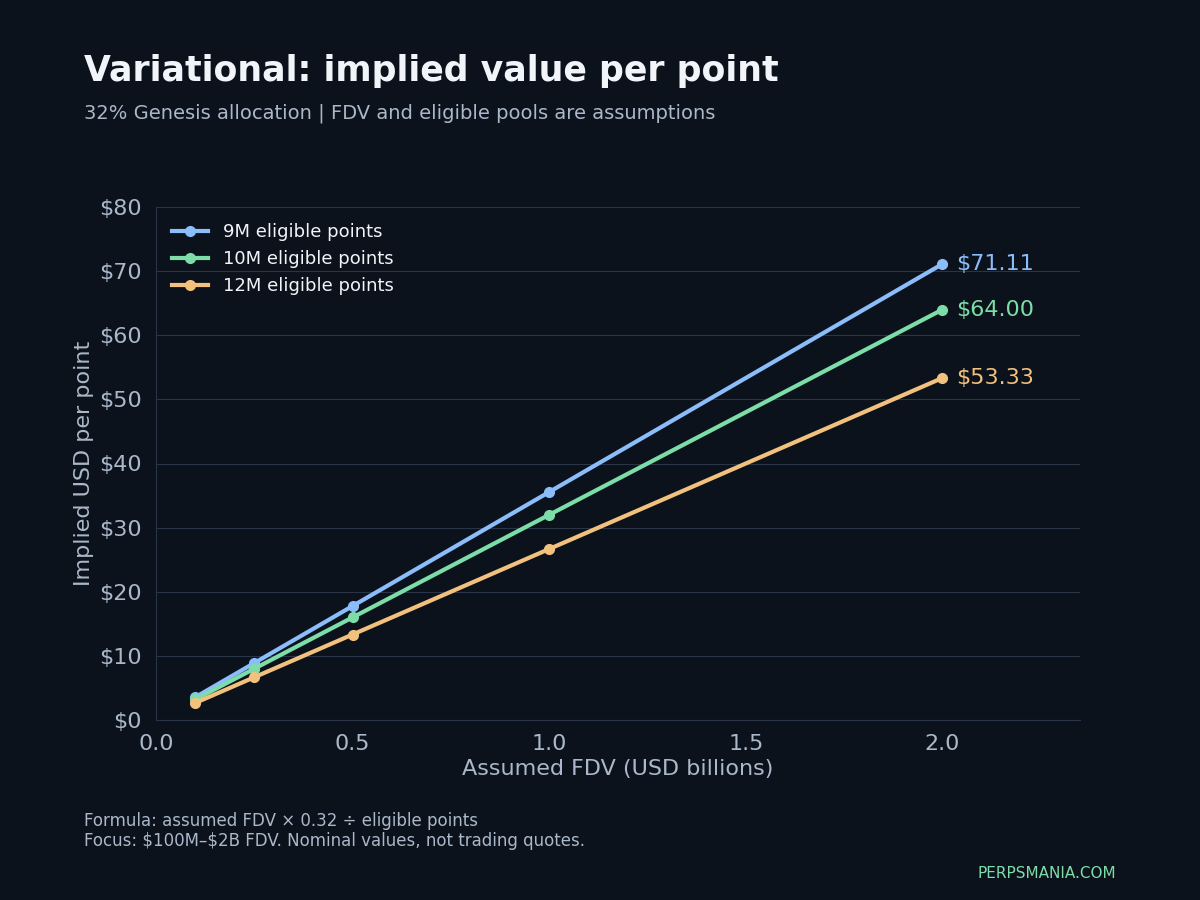
| Assumed FDV | $/point: 9M pool | $/point: 10M pool | $/point: 12M pool | 100 points: 10M pool |
|---|---|---|---|---|
| $100M | $3.56 | $3.20 | $2.67 | $320.00 |
| $250M | $8.89 | $8.00 | $6.67 | $800.00 |
| $500M | $17.78 | $16.00 | $13.33 | $1,600.00 |
| $1B | $35.56 | $32.00 | $26.67 | $3,200.00 |
| $2B | $71.11 | $64.00 | $53.33 | $6,400.00 |
| $5B | $177.78 | $160.00 | $133.33 | $16,000.00 |
| $10B | $355.56 | $320.00 | $266.67 | $32,000.00 |
The 100-point column uses the 10M-pool scenario. At $500M FDV, it implies $16 per point and $1,600 for 100 points. At $2B FDV, those figures become $64 and $6,400. These are the same ownership fractions priced at different assumed token valuations.
A complete example at $1B FDV
Take an illustrative account with 250 eligible points, a 10M-point final pool, and $1B FDV:
- Genesis pool value:
$1,000,000,000 × 0.32 = $320,000,000. - Implied point value:
$320,000,000 ÷ 10,000,000 = $32. - Account share of eligible points:
250 ÷ 10,000,000 = 0.0025%. - Nominal account allocation:
250 × $32 = $8,000.
That account would represent 0.0008% of total token supply under the simplified model: 0.0025% × 32%. It does not own 0.0025% of all tokens; its points determine a share of the Genesis pool.
Why the final points pool matters
At the same $1B FDV and 32% allocation, moving from 9M to 12M eligible points changes implied value from about $35.56 to $26.67 per point. That is a 25% reduction in value per point even though FDV is unchanged.
If you hold the same number of points while the pool grows, your share shrinks. If you earn additional points, compare your balance growth with growth of the entire eligible pool. Your balance can increase while your percentage share still decreases.
Keep the denominator and numerator consistent: use the pool relevant to the same distribution and the points actually eligible for it. Do not mix a current leaderboard total with a projected final balance without explaining the difference.
How to use the Variational calculator
Open the Variational airdrop and point-price calculator and enter:
- Points you hold: for example, 250.
- FDV assumption: enter 1 and select B for the $1B example, or 500 and M for $500M.
- Airdrop allocation: the calculator uses the announced 32% Genesis allocation.
- Total points estimate: enter 10 for a 10 million pool, or 9 or 12 to reproduce the sensitivity columns.
Results update as the inputs change. The calculator starts with a 10.35M model pool; it does not fetch a final eligibility snapshot. Enter 10 to reproduce this guide's central scenario. For a conversion-date estimate, replace that input with a sourced final pool if and when one is available.
Farming cost and break-even FDV
Suppose you spend $600 in net trading costs to obtain 50 eligible points. Your cost is $12 per point. Under the 10M-pool and 32%-allocation assumptions, the nominal break-even FDV is:
Break-even FDV = cost per point × final eligible points ÷ allocation
$12 × 10,000,000 ÷ 0.32 = $375,000,000
At a hypothetical $250M FDV, 50 points imply $400, a $200 shortfall against those costs. At $500M FDV, they imply $800, a $200 surplus before additional costs or tax. This is a sensitivity calculation, not a recommendation to farm or buy points.
Include spreads, fees, funding and realized trading losses when measuring acquisition cost. A points reward does not erase the risk of the trades used to obtain it. See the general points valuation guide for the broader framework.
Does the estimate equal cash at launch?
No. A nominal token allocation at an assumed FDV is not guaranteed sale proceeds. Market price, execution liquidity, eligibility, claim rules and selling costs can change what is realizable. The documented Genesis unlock removes that allocation's stated vesting restriction; it does not guarantee a particular price or immediate execution at that price.
Sources and assumptions
- Variational: $VAR allocation — the 32% pro-rata Genesis allocation, its stated unlock, and the published launch window.
- Variational: points program — points issuance mechanics and the right to change program rules.
- PerpsMania: Variational calculator — an editable scenario model, not an official allocation checker.
Sources checked on 29 October 2026. All FDVs, final points pools, account balances and farming costs in the examples are hypothetical. Figures assume equally weighted eligible points and exclude tax. PerpsMania is independent of Variational.
Check your own assumptions
Use the guide as a framework, then inspect the relevant markets and inputs on PerpsMania.
Open the Variational points calculatorEducational material, not personalized investment advice. Numerical examples are hypothetical unless explicitly identified as sourced market data. Perpetual trading can result in loss of all posted collateral. Some product pages contain referral links; PerpsMania may benefit when you use them.