
At a fixed position size, changing leverage does not multiply the dollar commission. It changes the fee as a share of simplified initial margin; increasing position size increases the fee base.
A fee of 0.05% can look small beside a 20x leverage setting. The important question is what the percentage applies to. Trading commissions are calculated on the executed position notional, not just the collateral you assign to the position. Leverage changes the relationship between those two amounts.
This guide separates two decisions: keeping the position size fixed while changing leverage, and keeping the margin budget fixed while increasing position size. They produce different dollar commissions, even when the fee rate is unchanged.
Separate notional, margin and fee rate
For a simple linear perpetual valued in USD, execution notional is the quantity filled multiplied by its execution price. A commission rate is applied to each fill. The collateral allocated to support that exposure is a different amount.
Hyperliquid's margin documentation describes initial margin using position size, mark price and leverage. Its fee documentation lists maker/taker schedules separately. The distinction is useful when comparing venues, but a specific contract's rules still control the actual calculation.
For the illustrations below:
Simplified initial margin = position notional / leverage
Round-trip commission = entry notional × entry fee rate + exit notional × exit fee rate
These are USD examples for a linear contract. They do not describe every inverse or coin-margined contract, and the margin formula is not a calculation of liquidation price or withdrawable balance. Fees, maintenance requirements, other positions and exchange rules can affect the collateral actually needed.
Keep the position fixed: the dollar fee stays the same
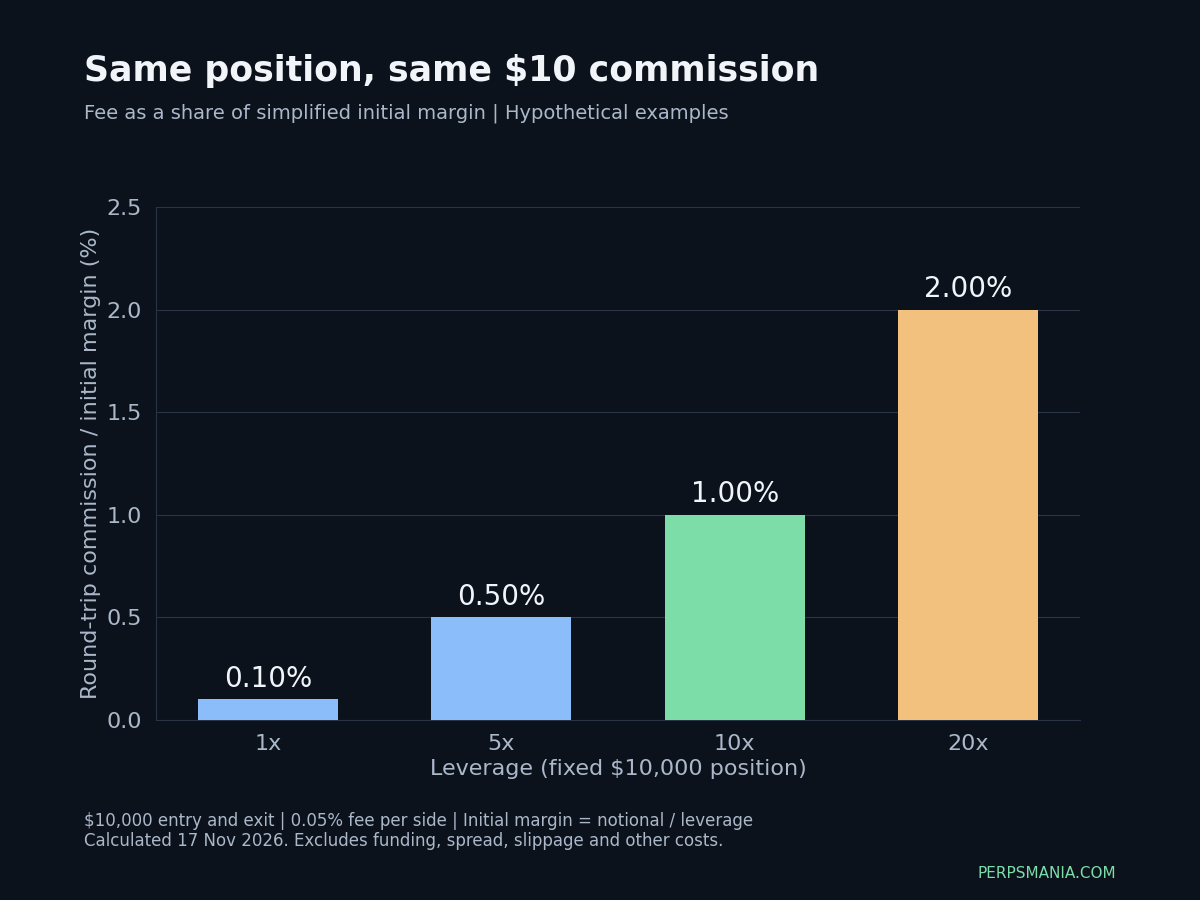
Assume a hypothetical $10,000 entry and $10,000 exit, each charged at 0.05%. The round-trip commission is:
$10,000 × 0.0005 + $10,000 × 0.0005 = $10
The 0.05% rate is an invented example, not a current quote for any named venue. Assume unchanged exit notional, no discounts and no other costs.
| Leverage | Position notional | Simplified initial margin | Round-trip commission | Commission / initial margin |
|---|---|---|---|---|
| 1x | $10,000 | $10,000 | $10 | 0.10% |
| 5x | $10,000 | $2,000 | $10 | 0.50% |
| 10x | $10,000 | $1,000 | $10 | 1.00% |
| 20x | $10,000 | $500 | $10 | 2.00% |
The same position pays the same $10 commission in every row. What changes is the margin denominator. At 20x, a $10 commission is 2% of the simplified $500 initial margin; it is not a 2% exchange fee on the $10,000 position.
Keep margin fixed: a larger position pays more dollars
Now hold the simplified margin budget at $1,000 and use it to support different position sizes. Keep the same hypothetical 0.05% commission per side and unchanged entry/exit notional.
| Leverage | Simplified initial margin | Position notional | Round-trip commission |
|---|---|---|---|
| 1x | $1,000 | $1,000 | $1 |
| 5x | $1,000 | $5,000 | $5 |
| 10x | $1,000 | $10,000 | $10 |
| 20x | $1,000 | $20,000 | $20 |
Here the dollar commission increases because the traded exposure increases. Moving from a $1,000 position to a $20,000 position multiplies the fee base by twenty. The leverage selector itself is not an extra fee multiplier applied after calculating commission on notional.
In this simplified model, with equal entry and exit notionals and fee rates:
Round-trip commission / initial margin = 2 × per-side fee rate × leverage
Expressing 0.05% as a decimal gives 2 × 0.0005 × 20 = 0.02, or 2%. Use actual fill notionals and rates when entry and exit differ. Trading fees may reduce account equity, so the table's margin budget should not be read as the exact total deposit needed to place and close a trade.
Distinguish selected leverage from actual account exposure
The leverage setting used for an order is not always the account's effective leverage after fills, price changes or collateral transfers. Cross margin can support several positions from shared collateral; isolated margin can have additional collateral attached to a particular position.
Consequently, dividing fees by simplified initial margin answers a narrow budgeting question. It does not measure the percentage of your entire wallet lost to fees, and it does not determine the distance to liquidation. Increasing leverage also changes the impact of adverse price moves relative to available collateral; this guide does not recommend a leverage level.
Compare the full trade, not only the commission
Use the PerpDEX fee comparison to shortlist maker and taker rates, then check the account tier and market rules at the venue. A resting order and an immediately executable limit order can receive different fee treatment. Our order-controls guide explains what post-only does and what it does not guarantee.
Add funding paid or received over the actual holding interval. Estimate spread and slippage at the position's notional size, not at its margin amount. A $20,000 position needs an executable quote for $20,000 even if its simplified initial margin is $1,000.
Read the VWAP and slippage example for that execution calculation. For a two-venue hedge, the funding break-even guide counts both positions and all four executions. Keep conditional points rewards outside the cash-cost budget until their terms can be evaluated separately.
Sources and assumptions
- Hyperliquid: margining — primary reference for initial-margin and cross/isolated distinctions.
- Hyperliquid: fees — primary reference for separate fee schedules and account-dependent rates.
Sources checked on 17 November 2026. All fee rates, notionals and leverage rows in the worked examples are hypothetical. The model assumes a linear USD-valued contract, identical entry and exit notional, a 0.05% fee on each execution and no rebates. It excludes price P&L, funding, execution shortfall, transfer costs, liquidation fees and taxes. Simplified initial margin excludes fees and is neither an account-equity forecast nor a liquidation threshold.
Check your own assumptions
Use the guide as a framework, then inspect the relevant markets and inputs on PerpsMania.
Compare PerpDEX maker and taker feesEducational material, not personalized investment advice. Numerical examples are hypothetical unless explicitly identified as sourced market data. Perpetual trading can result in loss of all posted collateral. Some product pages contain referral links; PerpsMania may benefit when you use them.