
Realized funding is the sum of signed settlement cash flows using each event’s eligible position and applied rate. A current quote or simple average cannot reconstruct changing exposure.
A funding quote describes a rate at a particular time. Your funding ledger records cash transfers that actually settled. When rates reverse or position size changes, multiplying the first quote by the number of hours can give a different answer from the sum of those transfers.
This guide reconstructs a hypothetical short position across four settlements. It is an accounting method for a completed holding period, not a forecast that the next rate will persist.
Start with the settlement record
For each funding event, keep the timestamp, market, position side, eligible position quantity, valuation reference and applied rate. If the venue already provides the actual funding cash transfer, preserve that value and use your reconstruction as a reconciliation check.
Hyperliquid's funding documentation describes hourly payments and a distinction between the rate calculation's eight-hour basis and the amount applied hourly. It also specifies oracle price, rather than mark price, when valuing position size for the payment. These are venue-specific rules, not defaults that can be copied to every PerpDEX.
Record the interval beside the number. An eight-hour equivalent, a predicted next rate and a final applied hourly rate are different inputs. Dividing an already hourly rate by eight would understate the payment; treating an eight-hour quote as an hourly payment could overstate it.
Apply a consistent cash-flow sign
In the worked example, positive settled rates mean longs pay shorts. Positive cash flows mean money received by the short; negative cash flows mean money paid by the short.
Short funding cash flow at settlement i = eligible USD notional_i × applied interval rate_i
Long funding cash flow at settlement i = -eligible USD notional_i × applied interval rate_i
Rates in these formulas are decimals: 0.01% is 0.0001. A venue statement might use the opposite sign to label a fee charged, so reconcile the convention before adding rows from different sources.
The following is a fictional linear USD-valued perpetual. Each rate is already the final rate for that single hourly settlement. The notionals are the eligible values at the venue's applicable reference price; they are not margin balances or trade-volume totals.
Reconstruct four changing settlements
Assume the short has $10,000 eligible notional for the first two events and $5,000 for the next two after a partial close. Treat these event notionals as given; real accounts must reconstruct quantity and reference price separately.
| Settlement | Applied hourly rate | Eligible short notional | Short receives / pays |
|---|---|---|---|
| S1 | +0.0100% | $10,000 | +$1.00 |
| S2 | +0.0200% | $10,000 | +$2.00 |
| S3 | -0.0100% | $5,000 | -$0.50 |
| S4 | +0.0050% | $5,000 | +$0.25 |
| Total | Not a rate | Not summed exposure | +$2.75 |
The third row is 5,000 × -0.0001 = -$0.50: the rate reversed, so the short paid funding. The fourth row is 5,000 × 0.00005 = $0.25 received.
Realized funding cash flow = $1 + $2 - $0.50 + $0.25 = $2.75
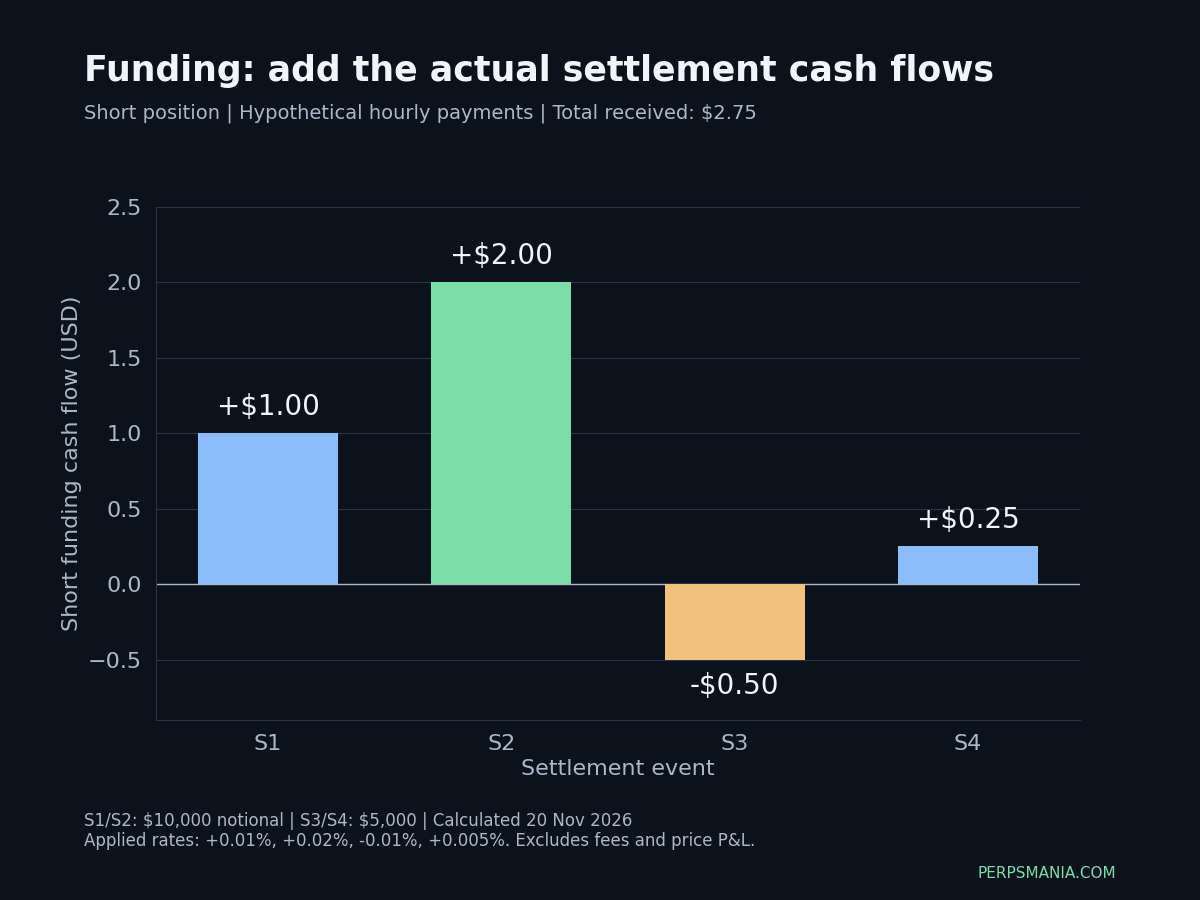
No row in this table is an observed market rate or an actual account result. The chart uses exactly the same four inputs as the table.
Why the first quote and an average can mislead
Projecting the first event's $1 receipt over four events would produce $4. That misses both the larger second rate and the later reduction in exposure and sign reversal. It is a constant-rate, constant-notional scenario, not a reconstruction of the four events.
A simple mean of the four rates is 0.00625% per event. Applying that average to the opening $10,000 notional for all four events gives $2.50, which also differs from $2.75. The mismatch arises because notional changed; multiplying each event's own rate and eligible notional preserves the pairing.
An annualized snapshot is even further removed from the ledger. Use our funding APR and APY guide to compare rate units, and keep the realized cash-flow total as a separate measure.
Reconcile changes in size, price and settlement time
A position reduction matters through the quantity eligible under the venue's settlement rules. Do not assume that any trade within the hour earns or pays an exact pro-rata fraction of an hourly quote. Check whether the venue uses a boundary snapshot, continuous accrual or another rule.
Even an unchanged base-asset quantity can have changing USD notional when its valuation price changes. Use the required reference rather than substituting entry price, current mark price or posted collateral. Inverse and coin-settled contracts require their own contract and currency treatment.
Save all timestamps in a common timezone, then compare the reconstructed event with the statement's timestamp and currency. Rounding can create small differences. Larger differences warrant checking sign, interval, quantity, price reference and whether an event is a settled payment or only a prediction.
Separate funding receipts from strategy profit
The example's $2.75 is funding received, not net trading profit. If the round trip incurs a hypothetical $8 in commissions, funding minus commission is 2.75 - 8 = -$5.25, before price P&L and any other costs. Do not add commissions again if a statement's net P&L already contains them.
For a two-venue hedge, reconstruct both funding ledgers using their own settlement clocks before combining signed cash flows. Include both positions' entry and exit costs; our four-execution break-even example explains that cost boundary.
Use the funding comparison tool to investigate current rates, then retain the underlying event records if you evaluate a completed setup. A present funding spread cannot reconstruct a past account's payments or guarantee the next settlement.
Sources and assumptions
- Hyperliquid: funding — primary reference for payment direction, hourly settlement, the eight-hour calculation basis and oracle-valued notional.
Source checked on 20 November 2026. Every rate, notional, cash flow and commission in the table and examples is hypothetical. The arithmetic assumes a linear USD-valued contract with rates already expressed for each individual hourly payment. It excludes price P&L, transfer charges, taxes, liquidation costs and other account adjustments. This is a ledger-reconciliation method, not a claim about any live funding opportunity or trading performance.
Check your own assumptions
Use the guide as a framework, then inspect the relevant markets and inputs on PerpsMania.
Compare funding rates across venuesEducational material, not personalized investment advice. Numerical examples are hypothetical unless explicitly identified as sourced market data. Perpetual trading can result in loss of all posted collateral. Some product pages contain referral links; PerpsMania may benefit when you use them.